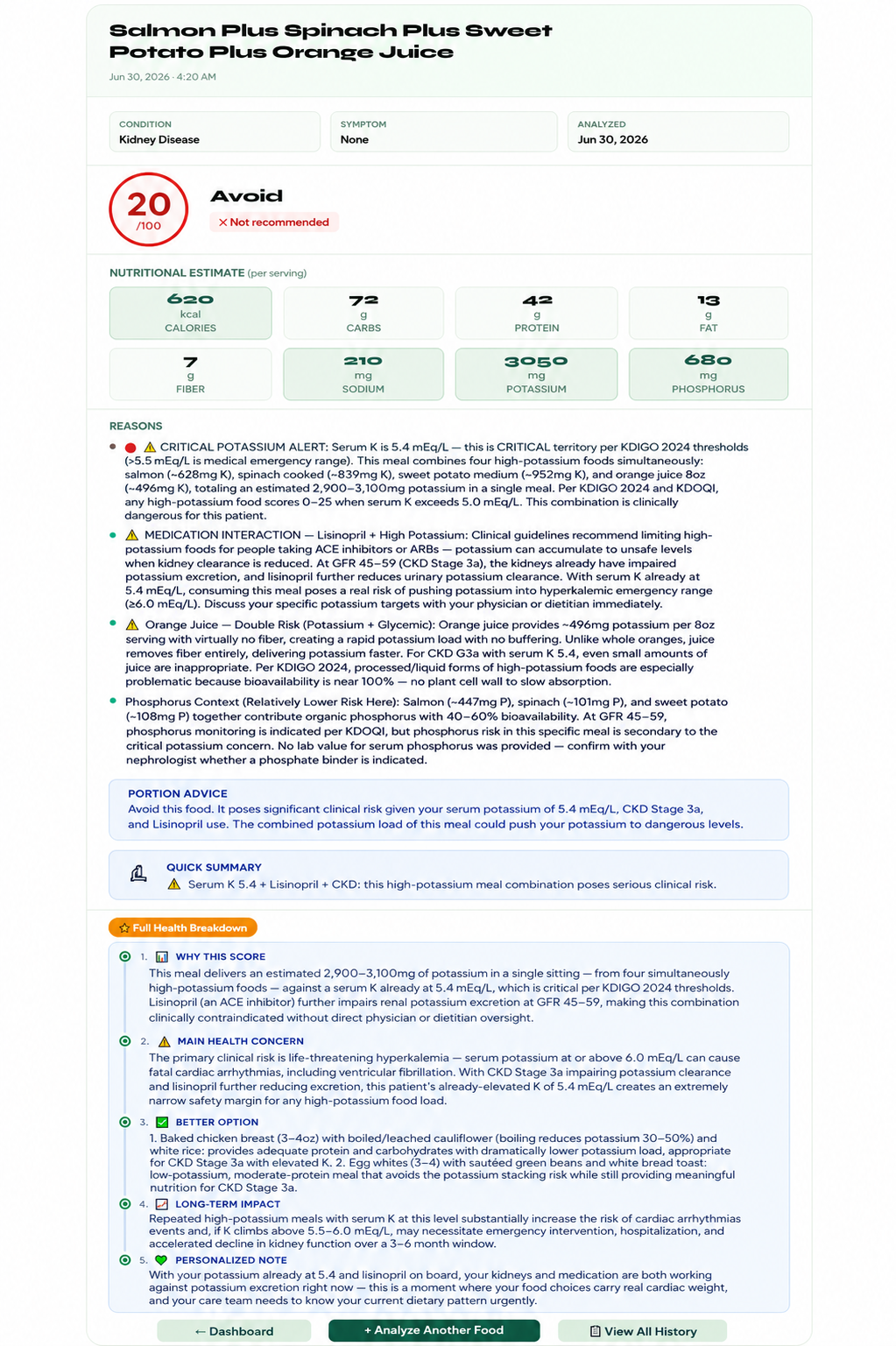
Lisinopril and CKD: Why Potassium Risk Is Compounded
What to Eat with Lisinopril and CKD
- Low-potassium proteins: egg whites (negligible potassium), fresh chicken, fresh fish — meet CKD protein targets without potassium loading
- Boiled, drained vegetables: green beans, cabbage, cauliflower, carrots — boiling and draining reduces potassium 30-50%
- White rice, pasta, bread: low-potassium, low-phosphorus staples appropriate for both conditions
- Consistent meals: consistency helps your nephrologist calibrate both your Lisinopril dose and potassium monitoring frequency to your actual dietary pattern
For the full breakdown of potassium amounts per serving and safe lower-potassium swaps, see our complete guide to Lisinopril and potassium-rich foods.
Does Lisinopril Help or Hurt the Kidneys?
Lisinopril helps the kidneys — this is the most important thing to understand about ACE inhibitors in CKD, because many patients fear the medication is damaging them when they see their creatinine rise after starting it. Lisinopril protects the kidneys by lowering pressure in the tiny blood vessels of the glomeruli, reducing the amount of protein leaking into urine (proteinuria), and slowing the progression of kidney damage over time. KDIGO 2024 and NKF guidelines both recommend ACE inhibitors as first-line therapy for CKD with proteinuria because the long-term kidney-protective benefit outweighs the short-term risks when managed appropriately.
What Serum Potassium Target Applies on Lisinopril with CKD?
With both Lisinopril and CKD present, the safe serum potassium range narrows — most nephrologists target 3.5-4.5 mEq/L rather than the broader normal range of 3.5-5.0. Above 5.0 mEq/L requires dietary review and possible dose adjustment. Above 5.5 mEq/L is a medical emergency. Regular potassium monitoring is not optional in this combination. It should be checked at every nephrology visit and more frequently if diet or medications change.
Why Creatinine May Rise When You Start Lisinopril on CKD
A small rise in creatinine of up to 30% above baseline is expected and acceptable when starting Lisinopril on CKD — this does not mean the medication is harming your kidneys. Lisinopril reduces pressure in the glomerular capillaries as part of its mechanism, which temporarily reduces the filtration rate and shows up as a creatinine rise. This is a predictable pharmacological effect, not kidney damage. Clinical guidelines consider this rise acceptable as long as it stabilizes within a few weeks. If creatinine rises more than 30% or continues to climb, contact your physician — your dose may need adjustment or another cause such as dehydration or bilateral renal artery stenosis may need to be investigated.
How Lisinopril Dose Affects Potassium Risk in CKD
The potassium-raising effect of Lisinopril is dose-dependent — higher doses produce greater potassium retention, which is why patients with CKD are often started on lower doses (2.5-5mg) rather than the standard starting dose of 10mg. Your dose is calibrated to your eGFR, baseline potassium, and blood pressure response. As eGFR declines, the dose is typically reduced to minimize hyperkalemia risk while maintaining the kidney-protective effect. This is one reason dietary potassium management becomes increasingly important as CKD progresses — the margin for dietary error narrows as both dose requirements and potassium retention increase.
How Lisinopril Reduces Proteinuria in CKD
One of the primary reasons Lisinopril is prescribed for CKD is its ability to reduce proteinuria — protein leaking from the kidneys into the urine — which is itself a marker of kidney damage and a driver of further progression. Lisinopril lowers the pressure inside the glomerular capillaries, reducing the mechanical force that pushes protein through the filtration barrier. This slows the progression from microalbuminuria (small amounts of protein) to macroproteinuria (large amounts) and slows overall GFR decline. The kidney-protective benefit is independent of blood pressure lowering — even CKD patients without high blood pressure benefit from ACE inhibitors when proteinuria is present.
What to Strictly Avoid with Lisinopril and CKD
- Salt substitutes: potassium chloride in salt substitutes is one of the most dangerous products for this combination — never use without explicit physician approval and current lab confirmation. See our full guide to Lisinopril and potassium-rich foods for why this specific risk is so easy to miss.
- High-potassium fruits, vegetables, and concentrated products: bananas, oranges, avocados, potatoes, coconut water, and concentrated tomato products (paste, sauce, ketchup) — standard high-potassium restriction applies with heightened urgency in this combination
- Potassium supplements: absolutely contraindicated without explicit physician direction
- NSAIDs: reduce both ACE inhibitor effectiveness AND accelerate CKD progression — double contraindication
The Compounding Effect Explained
Normal kidneys excrete 90% of dietary potassium through urine. CKD reduces this excretion capacity proportional to GFR decline. Lisinopril further reduces it by blocking aldosterone. The combined effect means the same dietary potassium load produces a significantly larger serum potassium rise than it would in someone without CKD who is not on Lisinopril. At CKD Stage 3 (eGFR 30-59) on Lisinopril, even moderate high-potassium foods can push serum K above safe thresholds. As GFR declines further into Stage 4, this compounding effect intensifies — which is why monitoring frequency shortens correspondingly (see below). A meal that would be acceptable for a hypertensive patient without CKD can be dangerous in this combination.
Dehydration Significantly Amplifies Risk on Lisinopril with CKD
Dehydration is one of the most dangerous acute risk factors for people taking Lisinopril with CKD — it reduces kidney blood flow at the same time Lisinopril is altering intrarenal hemodynamics, creating compounded acute kidney injury risk. Even mild dehydration from exercise, hot weather, vomiting, or diarrhea can precipitate a significant drop in kidney function and dangerous potassium accumulation in this combination. Stay well hydrated, reduce physical exertion in extreme heat, and contact your physician immediately if you develop significant vomiting or diarrhea. Never take NSAIDs for illness-related pain — ibuprofen and naproxen further reduce kidney blood flow and are contraindicated in this combination.
When Lisinopril May Need to Be Reduced or Stopped
While Lisinopril is kidney-protective, certain lab findings require dose reduction or temporary discontinuation — knowing these thresholds helps you understand when to contact your physician rather than waiting for your next scheduled appointment. Dose reduction is typically needed when serum potassium consistently exceeds 5.5 mEq/L despite dietary restriction, when creatinine rises more than 30% above baseline without stabilizing, or when eGFR drops below 15 mL/min/1.73m². Temporary discontinuation is sometimes advised during acute illness with significant dehydration, major surgery, or contrast dye procedures. Your physician makes these decisions — this information helps you recognize when lab results warrant prompt contact rather than waiting.
Angioedema — The Rare Emergency to Know About
Angioedema is a rare but potentially life-threatening side effect of ACE inhibitors including Lisinopril — it causes swelling of the lips, tongue, face, and throat and can obstruct breathing. It affects approximately 0.1-0.7% of patients, with higher risk in Black patients. If you notice swelling of your mouth, face, lips, or tongue while taking Lisinopril, contact your physician immediately. If the swelling is severe or begins to affect your ability to breathe, go to the nearest emergency room — this is a medical emergency. Angioedema is a permanent contraindication to all ACE inhibitors. If you develop it you will need to switch to an ARB (Losartan, Valsartan) — the dietary potassium restrictions remain essentially identical on ARBs.
The ACE Inhibitor Cough and Switching to an ARB
A persistent dry cough affects 10-15% of patients on ACE inhibitors including Lisinopril, and is the most common reason for switching to an ARB — but switching does not change your potassium dietary restrictions. ACE inhibitors cause this cough by blocking the breakdown of bradykinin. ARBs (Losartan, Valsartan, Candesartan, Olmesartan) do not cause this cough. However ARBs raise serum potassium through the same RAAS pathway — blocking angiotensin II receptors reduces aldosterone, which reduces potassium excretion. Every dietary restriction on this page applies equally to Losartan and all other ARBs prescribed for CKD. If you are switched, do not assume the potassium restrictions have relaxed.
Monitoring Requirements for Lisinopril with CKD
KDIGO 2024 recommends more frequent electrolyte and kidney function monitoring when RAAS blockers (ACE inhibitors or ARBs) are used in CKD. The monitoring frequency depends on CKD stage and baseline potassium — typically every 3-6 months at Stage 3, every 1-3 months at Stage 4. Any change in diet, medications, or illness warrants an earlier potassium check. If you develop significant diarrhea, vomiting, or reduced fluid intake while on this combination, contact your physician — acute illness significantly raises acute hyperkalemia risk.