Noom vs Platelytix: When Weight Loss Coaching Isn't Enough for CKD, Diabetes, and Drug-Food Interactions
Noom has impressively evolved as a weight loss platform — behavior coaching, GLP-1 medications, muscle defense, glucose forecasting. Here's the one thing it still can't do
For anyone who has ever been on a weight-loss journey, having a coach, physical or digital, guiding you along the way makes the process less daunting. You might skip a workout or indulge in a dessert yet still know your app will redirect you. For a generally healthy person, that model works well.
But for many people, a diet slip is the least of their concerns. Imagine navigating weight loss while also managing CKD, diabetes, hypertension, or a medication list with documented food interactions. A "healthy" meal recommended by a generic platform may not be healthy for you at all. A potassium-rich smoothie that earns a green score in most apps could be dangerous for someone on Lisinopril with an eGFR of 42. Most weight-loss platforms were never built to see that distinction.
Platelytix was. It's a food intelligence platform with personalized meal plans built around your conditions and lab values, a recipe library filtered by condition, dietary preference, and 11 cuisine categories, a scoring engine that evaluates whether any meal is safe for your specific health profile before you eat it, and CookGuide (live at platelytix.com/cookguide/), which generates on-demand recipes adapted to your exact health metrics.
The scoring is where most people start.
Not sure if a food is helping or working against you? Score any meal against your actual health profile.
Score a Meal Free: No Account NeededWhat Noom Does Well
Noom has come a long way from a simple calorie-tracking app.
At its core, Noom uses psychology-based behavior change (daily lessons, habit tracking, food logging, and coaching) to help people build long-term healthy habits rather than just count calories. Its color system categorizes foods by calorie density (green, yellow, red) and is paired with a structured curriculum on emotional eating, portion awareness, and sustainable lifestyle change.
Beyond that, Noom Med now offers GLP-1 medications directly (Ozempic, Wegovy, Zepbound, Mounjaro, liraglutide, compounded semaglutide, and oral options including Metformin), prescribed through online telehealth clinicians and shipped within 7 days if approved. Its GLP-1 Companion program, now free to anyone on a GLP-1 medication, adds protein target guidance, muscle preservation workouts through Muscle Defense, body composition scanning for lean mass and body fat percentage, glucose forecasting, side-effect support, and photo-based meal logging with individualized macro targets. Real-world data from over 30,000 Noom GLP-1Rx members showed that highly engaged users lost 25.2% more weight at week 40 and persisted 2.2x longer on medication than the least-engaged group.
In November 2025 Noom launched a dedicated Diabetes Lifestyle Program delivering clinically validated A1C reductions through behavioral coaching and glucose forecasting. In December 2025 it added Noom Menopause with HRT access. Its GLP-1 Companion program went free for any GLP-1 user in June 2026.
For a generally healthy person pursuing weight loss with or without GLP-1 medication, Noom is a genuinely strong platform.
Where Noom Stops
Despite everything it now does, Noom's architecture has a ceiling and it shows up clearly for anyone managing a condition that intersects with their medication list.
Noom does not have a medication interaction engine. It cannot tell you that your high-potassium smoothie is dangerous because you're on Lisinopril and your eGFR is 42. It won't flag that grapefruit interacts with your statin. It doesn't know that your salt substitute is potentially dangerous on spironolactone. Its GLP-1 Companion tracks protein targets and muscle health in general terms; it does not know that you're also managing CKD Stage 3b, where protein guidance changes entirely.
Noom does not integrate your lab values. Your serum potassium, GFR, phosphorus, A1C from your own bloodwork, and blood pressure readings don't enter Noom's scoring framework. A food that appears healthy based on calorie density may be clinically dangerous based on your actual labs that week.
Noom does not score for comorbidity stacking. CKD and diabetes simultaneously generate conflicting dietary guidelines: CKD says restrict protein, diabetes management says prioritize it for blood sugar control, and GLP-1 therapy says prioritize it to prevent lean mass loss. No single Noom recommendation resolves that conflict. Neither does its Diabetes Program, which was designed around diabetes in isolation.
Noom does not support CKD, hypertension, GERD, IBS, celiac, or hypothyroidism as scoring dimensions. These aren't gaps it's moving to fill; they're outside its clinical scope by design.
What Platelytix Does Differently
Platelytix scores every meal against your actual conditions, your specific medications, and your current lab values, using KDIGO 2024, ADA 2025, AHA 2026, ACLM/ASN/OMA/TOS 2025 Joint Advisory, and ACG guidelines simultaneously.
When Lisinopril is in your medication list alongside CKD, potassium-containing foods get flagged with the compound risk and the guideline behind it. When Semaglutide is in your profile, every meal is evaluated against the protein minimum of 20–30g per meal from the ACLM 2025 Joint Advisory, not just a general protein target. When your serum potassium comes back at 5.3 mEq/L, the scoring tightens beyond what your CKD stage alone would indicate. When you're managing CKD and diabetes simultaneously, both sets of guidelines apply to every score at once, and Platelytix flags where they conflict.
Seventeen specific drug-food interactions are built into the scoring engine by medication name, with plain-language explanations and care team handoff recommendations rather than generic warnings.
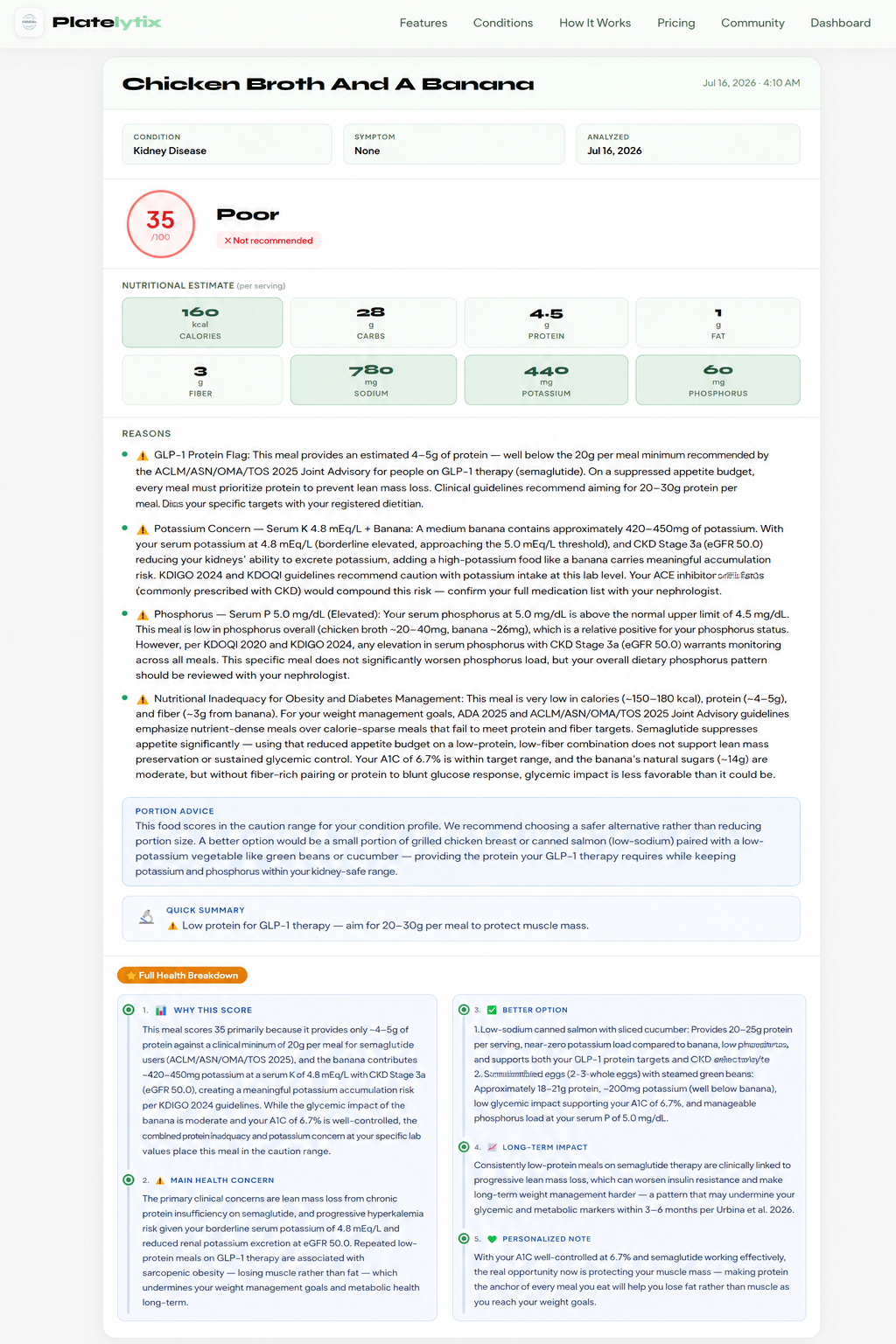
Real Platelytix output for a GLP-1 user on Semaglutide (Ozempic). Enter your meal, your medication, and your conditions, and see exactly what scores well and what doesn't for your profile specifically.
Browse condition-specific recipes filtered by your health profile, dietary preference, and cuisine, including GLP-1 friendly, CKD-safe, and low-sodium options across 11 cuisine categories.
Browse the Recipe LibraryFeature Comparison
| Feature | Noom | Platelytix |
|---|---|---|
| Behavior coaching and psychology curriculum | Yes: core feature | No |
| GLP-1 medication prescribing (telehealth) | Yes: Noom Med | No |
| GLP-1 Companion (protein, muscle, side effects) | Yes: free with GLP-1 program | Scored against your full medication and condition profile |
| Glucose forecasting | Yes: Noom Diabetes program | No |
| Body composition scanning | Yes: Noom Med | No |
| Photo-based meal logging | Yes | No: description and name based |
| Diabetes lifestyle program | Yes: employer and health plan focused | Scored against your A1C and diabetes medications |
| Medication interaction flags | No | Yes: 17 specific drug-food interactions by name |
| Lab value integration (GFR, serum K, P, A1C, TSH, BP) | No | Yes |
| CKD stage-specific scoring | No | Yes: KDIGO 2024, Stages 1–5 + dialysis |
| Comorbidity stacking | No | Yes: all conditions scored simultaneously |
| Hypertension, GERD, IBS, celiac, hypothyroid support | No | Yes |
| Cuisine preference filtering | No | Yes: 11 cuisine categories |
| Condition-aware weekly meal plans | No | Yes |
| On-demand recipe adaptation by health profile | No | Yes: CookGuide |
| Price | Noom Weight: $17.42/month (annual) or $59–70/month. Noom Med (telehealth only): $69/month. Noom Microdose GLP-1Rx: from $149/month. Full GLP-1 program: $299/month thereafter | $7.99/month or $59.99/year (~$5/month) |
Who Noom Is For
Noom is the right tool if your primary goal is weight loss supported by behavioral coaching, and you want the option of GLP-1 medications with telehealth oversight. If you're generally healthy, or managing diabetes and obesity as your main conditions, Noom's ecosystem is genuinely comprehensive. Its GLP-1 Companion is a meaningful addition for people who need structure around protein, muscle preservation, and side-effect management on semaglutide.
Who Platelytix Is For
Platelytix is built for people whose food choices carry real clinical stakes beyond weight loss. If you're on Ozempic and also managing CKD or hypertension, Platelytix applies every condition and medication simultaneously, something Noom's architecture doesn't do. If you're on Warfarin, ACE inhibitors, statins, phosphate binders, or diuretics, Platelytix flags what those medications mean for your plate. If your most recent labs changed what's safe to eat, Platelytix reflects that.
Can You Use Both?
Yes, and for some patients it makes sense. Noom handles the behavioral layer, GLP-1 prescribing, and habit coaching. Platelytix handles the clinical nutrition safety layer: what's actually safe to eat given your full medication and condition profile. The two tools address different parts of the same problem and don't overlap in their core functions.
CookGuide rebuilds meals like this one around your specific labs, medications, and restrictions, so a meal that flags poorly can be adapted into one that scores well instead.
Try CookGuide Set Up Your Health ProfileFrequently Asked Questions
Is Noom or Platelytix better for weight loss on Ozempic?
It depends on what you need. Noom's GLP-1 Companion program (now free for anyone on a GLP-1 medication) provides protein guidance, muscle preservation workouts, body composition tracking, and side-effect support. Platelytix scores every meal against your GLP-1 medication profile, flagging low-protein meals against the clinical minimum of 20–30g per meal per the ACLM 2025 Joint Advisory, and applies any comorbid conditions simultaneously. If you're also managing CKD or hypertension alongside Ozempic, Platelytix applies all conditions and medications at once, which Noom's GLP-1 Companion doesn't do.
Does Noom work for people with CKD or kidney disease?
Noom was not designed for CKD management. It does not track phosphorus, does not apply CKD-stage-specific potassium or protein limits, and its calorie-density color system has no mechanism for flagging foods that are dangerous given a specific eGFR or serum potassium level. Healthline's Noom review notes that people with health conditions like kidney disease should consult a healthcare professional before changing their diet. Platelytix applies KDIGO 2024 guidelines (including GFR-tiered electrolyte thresholds and the inorganic vs organic phosphorus distinction) to every meal scored.
Can Noom flag drug-food interactions?
No. Noom does not have a medication list or drug-food interaction engine. Its food scoring is based on calorie density, not your specific medication profile. If you're on Warfarin, Lisinopril, a statin, or a diuretic, Noom has no way to flag that certain foods interact with those medications. Platelytix flags 17 specific drug-food interactions by medication name, with plain-language explanations and care team handoff recommendations built into every relevant score.
What is the difference between Noom and Platelytix for diabetes?
Noom launched a Diabetes Lifestyle Program in November 2025 focused on behavioral coaching, A1C reduction through habit change, and glucose forecasting, primarily available through employer and health plan channels. Platelytix scores every meal against your A1C level, your diabetes medications including SGLT2 inhibitors, GLP-1 agonists, and Metformin, and any comorbid conditions like CKD or hypertension that change what a safe diabetic meal looks like for you specifically. The two tools address different parts of the problem and can work together.
Is Noom worth it for someone on multiple medications?
Noom is worth it if your primary goal is behavioral: building better habits, portion awareness, and a healthier psychological relationship with food. It is not designed to account for medication interactions, drug-food conflicts, or lab-value-specific dietary targets. For someone on multiple medications (ACE inhibitors, phosphate binders, statins, diuretics, GLP-1 agonists), the gap between a calorie-dense food and a safe food given your medication profile is exactly the problem Platelytix was built to solve.
How much does Noom cost compared to Platelytix?
Noom Weight costs $17.42/month on an annual plan or $59–70/month on a monthly basis. Noom Med (which includes telehealth and GLP-1 medication access) starts at $69/month for telehealth only, $149/month for the Microdose GLP-1Rx program, and $299/month for the full GLP-1Rx program thereafter. Platelytix costs $7.99/month or $59.99/year (~$5/month) and includes meal scoring against your full health profile, condition-aware meal plans, a recipe library across 11 cuisine categories, and CookGuide for on-demand recipe adaptation.
Disclaimer: This article is for educational purposes only and does not constitute medical advice. Always consult your physician, nephrologist, or registered dietitian before making dietary changes.