DaVita Diet Helper vs Platelytix: Which CKD Tool Is Built for Your Full Health Picture?
DaVita Diet Helper has served kidney patients for over 15 years with vetted recipes and meal plans. Platelytix was built for the moment your CKD profile gets more complicated — medications, comorbidities, and lab values that change what's safe to eat every day.
Living with CKD brings a constant challenge that goes beyond managing the condition itself including figuring out what's actually safe to eat, especially when comorbid conditions like diabetes or hypertension add their own conflicting dietary rules. Platelytix was built to handle that complexity: real-time meal scoring against your actual labs and medications, personalized meal plans that account for multiple conditions simultaneously, cuisine-preference filtering across 11 food cultures, and CookGuide for on-demand recipe adaptation built around your profile.
DaVita Diet Helper is one of the well-known resources in CKD nutrition with 1,000+ vetted kidney-safe recipes and structured weekly meal plans. For patients who need a free recipe source, it delivers. Where it stops is where Platelytix begins: the medication list, the live lab values, the comorbid conditions that change what "kidney-safe" actually means for you specifically.
The meal score is the fastest way to see the difference.
See how your own meals score against your exact CKD profile: labs, medications, and comorbid conditions included.
Score a Meal Free: No Account NeededHere's how the two tools compare across the features that matter most for CKD patients.
DaVita Diet Helper has been around since 2008. For a tool in a niche this specific, that longevity means something. It's been used by dialysis patients, renal dietitians, and nephrologists for over fifteen years, and DaVita is the largest dialysis provider in the United States.
For many patients it was the first dedicated kidney diet resource they encountered. This comparison looks at what it still does well, where it's been outpaced, and where Platelytix adds something it doesn't address.
What DaVita Diet Helper Does Well
DaVita Diet Helper's primary strength is its recipe library and meal planning infrastructure. It offers over 1,000 kidney-friendly recipes, pre-built weekly meal plans, nutrition tracking, shopping list generation, and printable reports for sharing with your care team.
The tool is built around 24 unique kidney diet prescriptions covering the range of CKD stages, dialysis types, and related condition combinations that renal dietitians encounter. Its recipes are developed and vetted by DaVita's team of renal dietitians, which gives them a level of clinical credibility.
For patients who primarily need a structured source of kidney-safe recipes and basic nutrient tracking, DaVita Diet Helper remains a solid free starting point, particularly for dialysis patients already in the DaVita system.
Where DaVita Diet Helper Falls Short
DaVita Diet Helper was designed around the DaVita patient population primarily late-stage CKD and dialysis patients, and its feature scope reflects that. For earlier-stage CKD patients, and particularly for those managing comorbid conditions, several significant gaps appear.
The tool does not incorporate medication interactions. A dialysis patient on phosphate binders, a CKD patient on an ACE inhibitor and a potassium-sparing diuretic, a CKD patient newly started on Ozempic; none of these medication contexts change what the tool recommends. It sees the kidney diet and nothing else.
Lab value integration is absent. DaVita Diet Helper operates on preset diet prescriptions. It does not allow you to enter your current serum potassium, GFR, phosphorus, or A1C and have those values dynamically adjust what it recommends for you that day. A patient whose serum potassium just came back at 5.3 mEq/L faces a very different dietary reality than one at 4.1, even if they're the same CKD stage.
Comorbid condition scoring is limited to what's built into the 24 preset prescriptions. If you're managing CKD, diabetes, and hypertension simultaneously (and a significant portion of CKD patients are), the dietary advice for each condition conflicts in ways the preset prescription structure can't fully resolve. The protein conflict between CKD restriction and diabetes management, the potassium paradox between CKD restriction and hypertension benefit, and the sodium targets across all three are not reconciled dynamically.
The tool is web-based and most functional on desktop. Its mobile experience has historically been inconsistent.
The food scoring is based on pre-vetted recipes rather than real-time meal analysis. You can track nutrients, but you cannot enter an arbitrary meal ("chicken tikka masala from the restaurant I just ordered from") and receive a condition-specific safety score with medication flags.
What Platelytix Adds
Platelytix approaches the same problem (what should a CKD patient eat) from a different direction. Rather than providing a curated recipe library, it analyzes any meal you enter against your complete health profile in real time.
For CKD specifically:
Lab-value-level scoring. Platelytix applies KDIGO 2024 thresholds adjusted to your actual lab values, not just your stage. If your serum potassium came back elevated at your last appointment, the scoring tightens accordingly until you update your labs again.
Phosphate binder timing. Flagged explicitly when those medications are in your profile. This is a clinical detail that significantly affects medication effectiveness and that most patients are never clearly told about at point of prescribing.
Comorbid conditions scored simultaneously: CKD + diabetes, CKD + hypertension, CKD + heart disease. All conditions apply to the score at once, with the scoring system applying the relevant guideline for each and flagging where they conflict.
Medication interactions by name. 17 specific drug-food combinations are flagged with plain-language explanations and a care team handoff recommendation rather than generic warnings.
Cuisine preference. CKD patients from West African, Caribbean, South Asian, or Latin American backgrounds face the kidney diet recommendations against food cultures built around foods that are frequently high in potassium, phosphorus, or sodium: yams, plantains, beans, rice dishes with coconut milk. Platelytix accounts for cuisine preference in its meal plan generation and recipe filtering, so the tool doesn't just tell a Jamaican patient they can't eat anything familiar.
CookGuide. Generates personalized recipe instructions on demand, adapted to your full CKD profile. If a CKD Stage 3a patient wants to make a traditional dish but needs substitutions for high-phosphorus or high-potassium ingredients, CookGuide generates the adapted recipe, specifies exact portion sizes with visual guidance, and flags any ingredient that conflicts with their medication list or lab values.
See CookGuide adapt a recipe to your exact CKD profile: cultural dishes included, with medication-safe substitutions.
Try CookGuide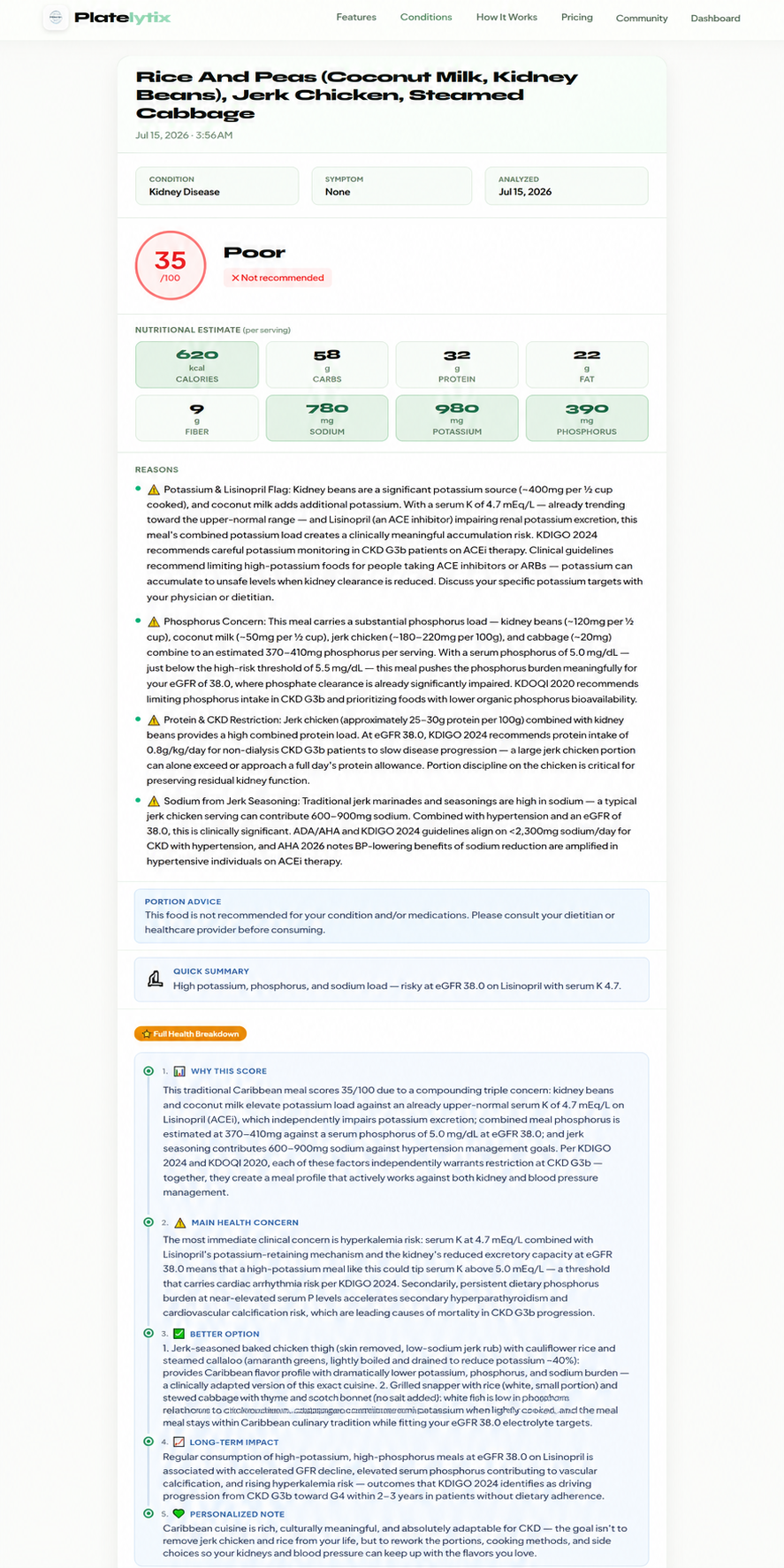
Rice and peas (coconut milk, kidney beans), jerk chicken, steamed cabbage. Profile: CKD Stage 3b + Hypertension + Lisinopril + Caribbean cuisine preference. A culturally common meal scored against a real comorbid profile: showing what's safe, what needs adjustment, and why.
Head-to-Head Comparison
| Feature | DaVita Diet Helper | Platelytix |
|---|---|---|
| CKD recipe library | 1,000+ dietitian-vetted recipes | Recipe browser with condition and cuisine filters |
| Real-time meal analysis | Nutrient tracking against preset prescriptions | Any meal scored against your full health profile |
| Medication interaction flags | None | 17 specific drug-food interactions by name |
| Lab value integration | Preset prescriptions only | GFR, serum K, serum P, albumin, PTH, A1C, TSH, blood pressure |
| Comorbid condition scoring | Limited to 24 preset combinations | Dynamic simultaneous stack across all conditions |
| Cuisine preference | Western-centric | 11 cuisine categories including Caribbean, West African, South Asian |
| GLP-1 / Ozempic therapy | Not addressed | Full protein and micronutrient flags per ACLM 2025 |
| Phosphate binder timing | Not flagged | Flagged with every relevant meal |
| On-demand recipe adaptation | Not available | CookGuide: on-demand adapted recipes by profile |
| Mobile experience | Limited: most functional on desktop | Web-based, mobile optimized |
| DaVita patient integration | Yes | No |
| Price | Free | $7.99/month or $59.99/year (~$5/month) |
Who Should Use Which
Use DaVita Diet Helper if: You are a DaVita dialysis patient, want a free source of vetted kidney-safe recipes and structured weekly meal plans, and don't have significant comorbid conditions or medication interactions to account for.
Use Platelytix if: You're managing CKD alongside diabetes, hypertension, or other conditions, have a medication list with documented food interactions, have current lab values that should influence your daily food choices, or want real-time meal scoring for any food you're considering, not just pre-vetted recipes.
Use both if: You use DaVita Diet Helper's recipe library for structured meal ideas and cooking guidance, and Platelytix to score specific meals before eating them, particularly when eating out, ordering in, or trying something outside the recipe library.
Set up your full CKD profile (stage, labs, medications, and comorbid conditions) and get personalized scoring from your first meal.
Set Up Your Health Profile Score a MealDisclaimer: This article is for educational purposes only and does not constitute medical advice. Always consult your nephrologist or renal dietitian before making dietary changes.