One Meal Planner That Knows Your Conditions, Medications, and Labs
Most meal planners know your calorie goal. Platelytix knows your GFR, your A1C, your medications, your potassium level, and what you actually like to eat then scores every meal and curates recipes accordingly.
More than three in four American adults are living with at least one chronic condition. Cardiovascular diseases, hypertension, diabetes, kidney disease, IBS — conditions that affect tens of millions of people, and a growing number are managing two, three, or four of these simultaneously, often alongside medications that add their own dietary rules on top.
Yet when these people go looking for a meal planner, they find tools built for someone else. Apps that count calories. Apps that track macros. Apps that suggest "eat more vegetables" without knowing that certain vegetables are high in potassium — a mineral that, for someone with kidney disease or on an ACE inhibitor, requires careful monitoring.
Generic meal planning is not a minor inconvenience for people managing chronic conditions. It's a structural mismatch between what these tools were built for and what these people actually need.
What Platelytix Actually Does
Platelytix is a personalized meal planning and food scoring tool. You enter your health profile — your conditions, medications, allergies, most recent lab values, dietary preferences, cuisine preferences, health goals, and weekly grocery budget — and Platelytix uses that information to score every meal you analyze and curate recipes that actually fit your health picture.
Every score references current evidence-based guidelines: KDOQI 2020 and KDIGO 2024 for kidney disease, ADA 2025 and 2026 Standards of Care for diabetes, AHA 2026 for heart health, Monash University guidelines for low-FODMAP, and ACG guidelines for GERD. The score tells you not just whether a meal is good or bad, but specifically why — which guideline flagged it, which nutrient is the concern, and what your lab values have to do with it.
This is what separates Platelytix from every other meal planner on the market. Not a bigger recipe database. Not a prettier interface. The depth of what it knows about you before it ever scores a meal.
Personalized Meal Planning for GLP-1 Users (Ozempic, Wegovy, Mounjaro, Zepbound)
People searching for what to eat on Ozempic, GLP-1 friendly meal plan, or best foods while on Wegovy are navigating a set of nutritional priorities that most meal planners aren't built for. Semaglutide and tirzepatide significantly slow gastric emptying — meaning high-fat meals, large portions, and certain high-fiber foods create real digestive discomfort. At the same time, GLP-1 medications suppress appetite so effectively that nutrient depletion becomes a genuine risk: vitamin D, iron, B vitamins, calcium, and protein all require deliberate attention when total food intake drops.
For someone on Ozempic who also has CKD — a combination the FDA specifically recognized when it approved semaglutide for kidney protection in type 2 diabetes in January 2025 — the picture is more complex still. Higher protein intake recommended for muscle preservation on GLP-1 therapy works directly against kidney preservation goals in CKD Stages 3–4.
Platelytix accounts for all of this simultaneously. A meal scored for a GLP-1 user reflects both the gastric emptying constraints of the medication and the nutrient targets appropriate for any comorbid conditions in the profile. No other meal planner or food scoring tool does this.
Personalized Meal Planning for Chronic Kidney Disease (CKD)
People searching for kidney disease meal plan, CKD diet tracker, foods to avoid with kidney disease, or how to track potassium and phosphorus need more than a nutrient counter. They need a tool that understands CKD staging — because the dietary rules for CKD Stage 2 (GFR 60–89) are meaningfully different from Stage 4 (GFR 15–29), and different again for someone on hemodialysis or peritoneal dialysis, where protein needs actually reverse.
They also need a tool that understands inorganic phosphorus. Phosphate additives — sodium phosphate, calcium phosphate, phosphoric acid — are used in processed meats, fast food, packaged snacks, cola drinks, and many canned products. They don't appear on the nutrition facts panel, and they absorb into the bloodstream at over 90% efficiency, compared to 40–60% for naturally occurring phosphorus in whole foods. A processed ham sandwich and a fresh piece of chicken might show similar phosphorus numbers on paper. In the body, they behave very differently.
Platelytix's scoring engine accounts for this distinction. It also adjusts potassium flagging dynamically based on your serum potassium from your most recent labs, and stacks ACE inhibitor and ARB compound risk if those medications are in your profile — because Lisinopril, for example, independently raises serum potassium, which changes how aggressively dietary potassium needs to be managed.
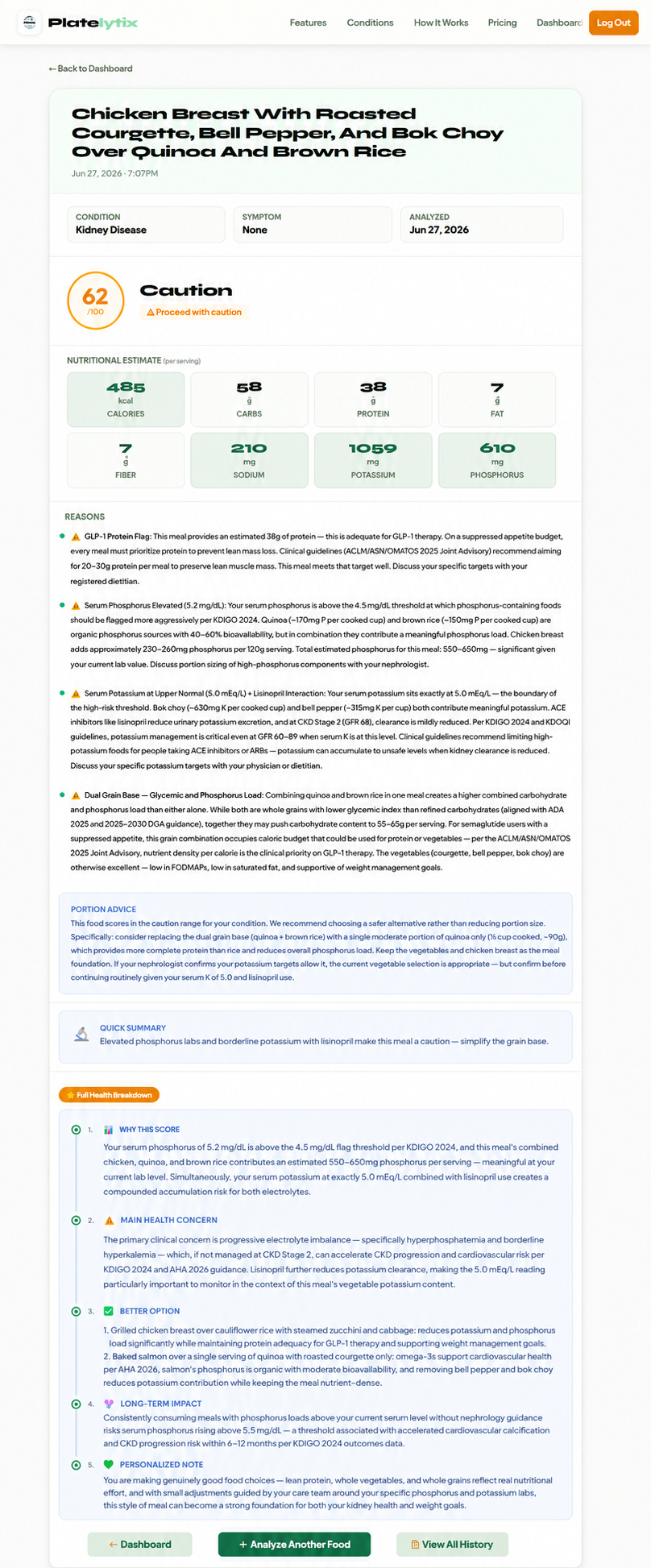
Demo — CKD Stage 2, Hypertension, Lisinopril + Ozempic. Score: 62/100 — Caution ⚠. Platelytix flags elevated serum phosphorus, borderline potassium compounded by Lisinopril, and gastric emptying risk from semaglutide — simultaneously.
Personalized Meal Planning for Type 2 Diabetes
People searching for diabetic meal plan, blood sugar friendly foods, foods that lower A1C, or meal planner for type 2 diabetes are often given advice calibrated for a population average. Platelytix knows your A1C. It knows whether your primary concern is post-meal glucose spikes, weight management, cardiovascular risk, or a combination — because you entered those goals when you set up your health profile.
For someone managing type 2 diabetes alongside kidney disease, the standard diabetic meal plan creates conflicts: the high-fiber whole grains most recommended for blood sugar control carry potassium and phosphorus loads that can be problematic for damaged kidneys. Platelytix surfaces these conflicts in the score and explains exactly which trade-off is being flagged and why — so you can make an informed choice rather than follow advice that was designed for someone who doesn't share your full health picture.
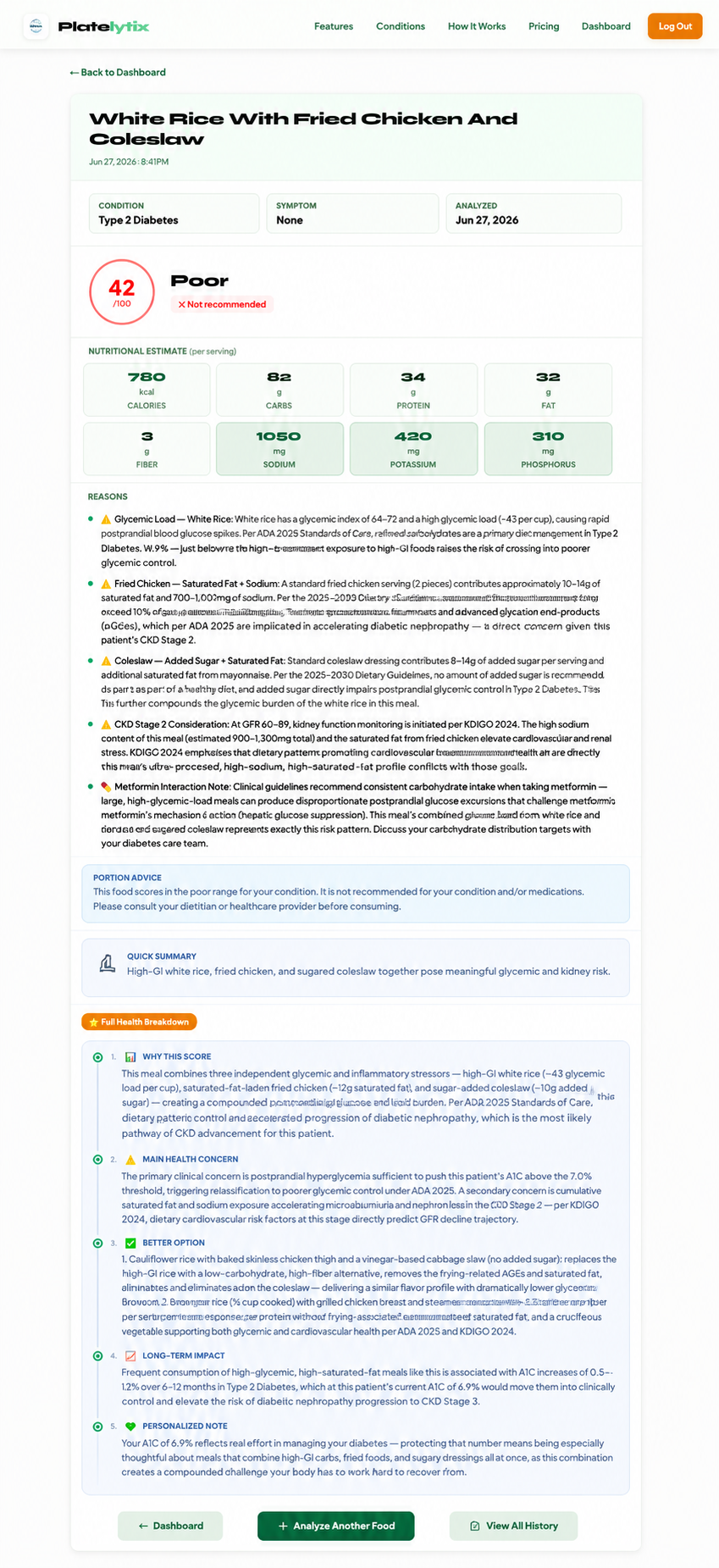
Demo — Type 2 Diabetes profile. Platelytix scores against your A1C and glucose targets, not a population average.
Personalized Meal Planning for Hypertension, Heart Disease, and High Cholesterol
People searching for low sodium meal plan for high blood pressure, heart healthy meal planner, or diet for high cholesterol and hypertension frequently don't know that their medication changes the equation. Someone on a loop diuretic — furosemide or hydrochlorothiazide — who also aggressively restricts sodium on top of the medication can develop hyponatremia, a dangerous drop in blood sodium. Someone on a statin who eats grapefruit is triggering a well-documented drug-food interaction that affects how the medication is metabolized.
Platelytix knows which diuretics cause sodium excretion and scores meals accordingly. It flags the statin-grapefruit interaction. It references AHA 2026 dietary guidance for cardiovascular risk and DASH diet principles for blood pressure management. For someone managing hypertension, heart disease, and high cholesterol simultaneously, the scoring engine accounts for all three at once, rather than flagging each in isolation.
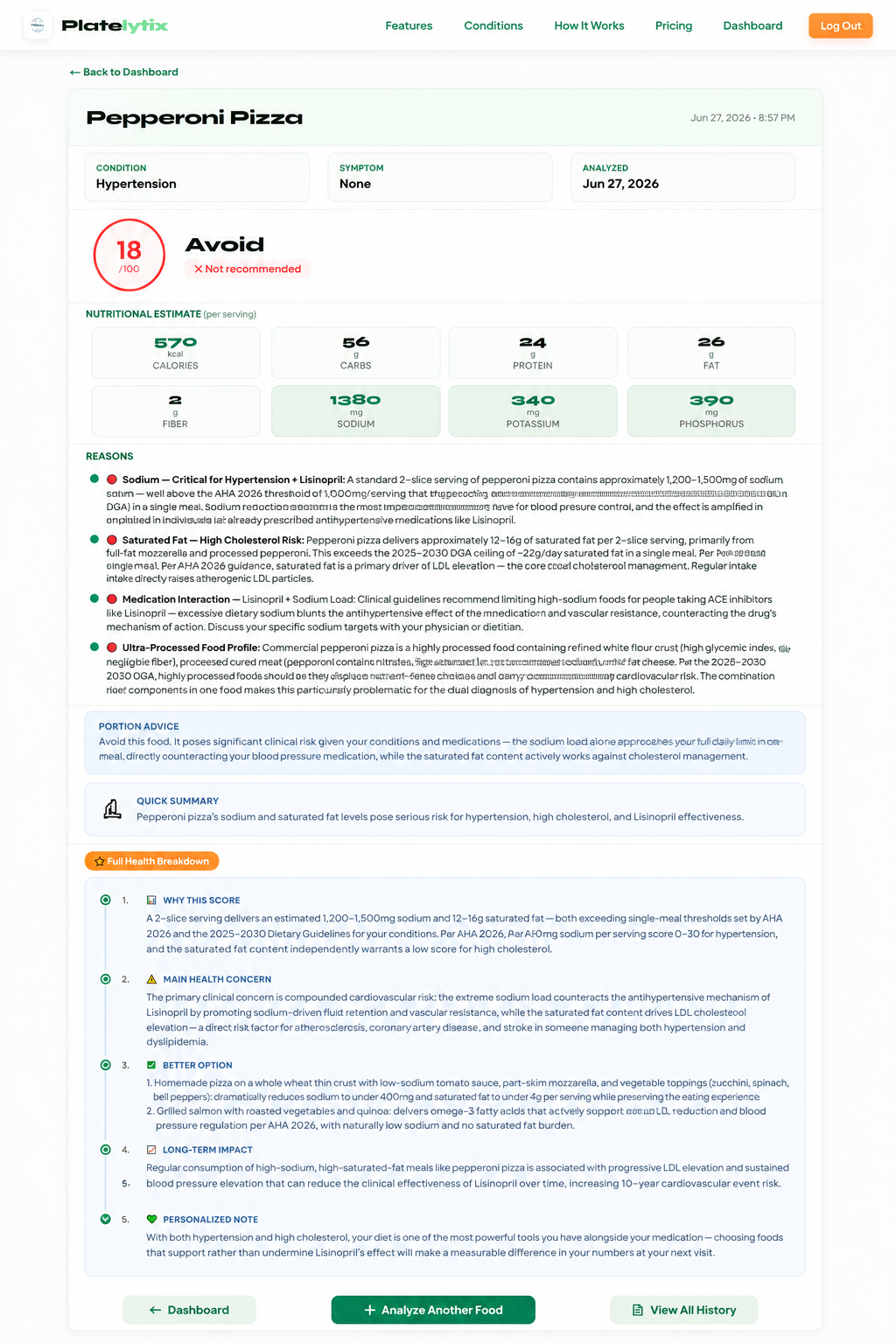
Demo — Hypertension + Heart Disease profile. Platelytix flags sodium load, diuretic interactions, and cardiovascular risk simultaneously.
Personalized Meal Planning for IBS and Low-FODMAP Diets
People searching for low FODMAP meal plan, what to eat with IBS, or foods that trigger IBS flares face a uniquely complex dietary landscape. Garlic and onion are hidden in almost every packaged food and restaurant sauce. Certain vegetables shift from low to high FODMAP purely based on serving size — a detail most food apps don't account for at all. And for someone managing IBS alongside another condition, the overlapping dietary constraints quickly become unmanageable to track manually.
Platelytix scores meals against Monash University low-FODMAP guidelines, including serving-size-dependent FODMAP thresholds. It also cross-references those constraints with any other active conditions in your profile — so someone managing IBS and hypertension simultaneously gets a score that reflects both sets of dietary rules, not just one.
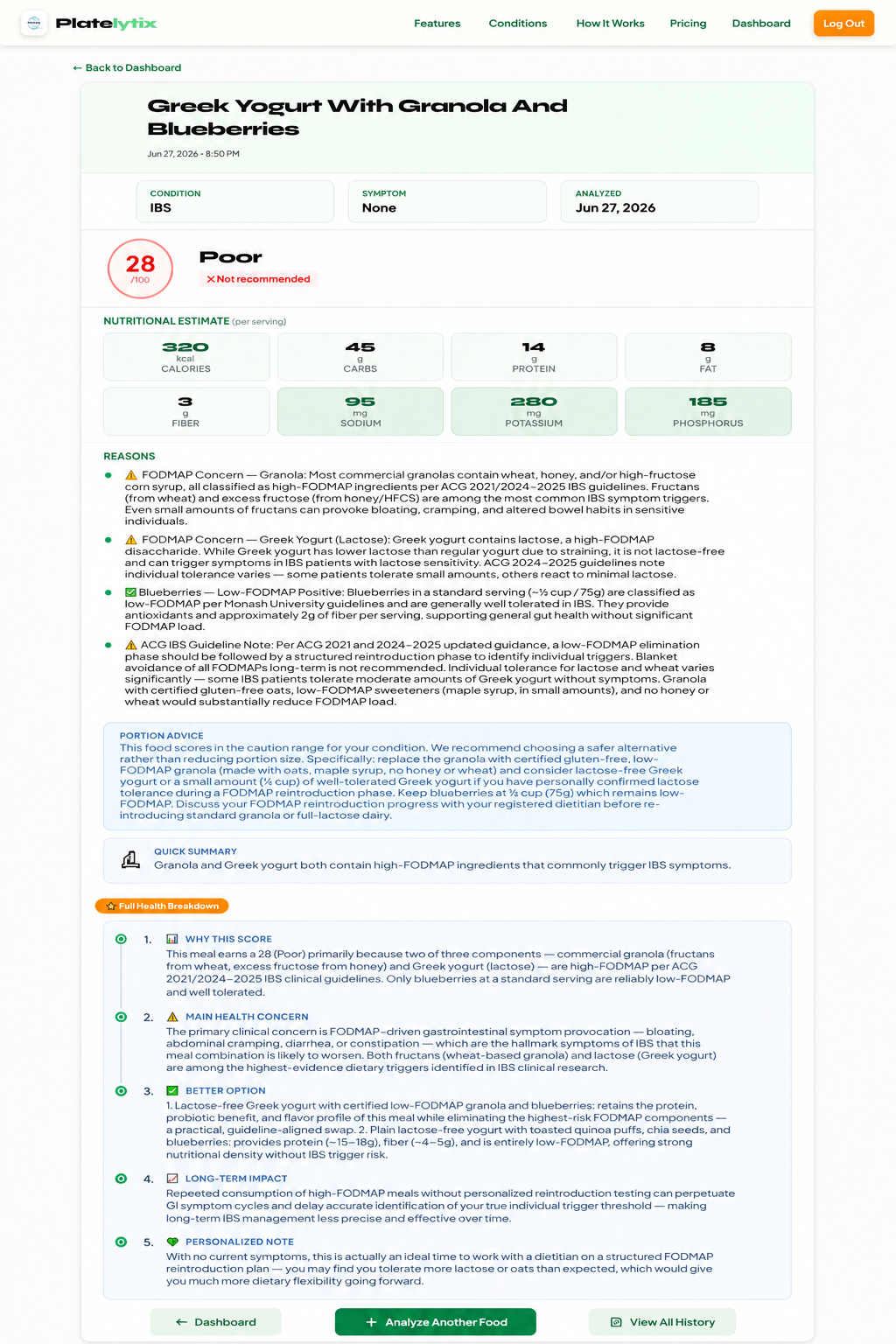
Demo — IBS / Low-FODMAP profile. Platelytix references Monash University guidelines including serving-size-dependent FODMAP thresholds.
Beyond Conditions: What Else Platelytix Understands About You
This is where Platelytix separates itself from tools focused purely on medical parameters. A meal plan that fits your conditions but ignores everything else about you isn't actually personalized — it's just medically filtered.
Platelytix also accounts for:
- Dietary preferences — vegan, vegetarian, pescatarian, keto, halal, kosher, gluten-free, dairy-free, high-protein, low-carb, and more. Your condition-appropriate meals are filtered through your dietary identity, not just your diagnosis.
- Cuisine preferences — West African, Caribbean, South Asian, East Asian, Southeast Asian, Middle Eastern, Latin American, Mediterranean, and more. Condition-appropriate eating doesn't have to mean eating like you don't have a culture. Platelytix's recipe library spans 150+ globally diverse recipes, adapted for chronic conditions without erasing the food traditions they come from.
- Health goals — lose weight, build muscle, manage a condition, reduce inflammation, maintain weight. The scoring reflects where you're trying to go, not just where you currently are medically.
- Weekly grocery budget — recipes are tagged by estimated cost per serving, so the meal plan is filtered not just by what's appropriate for your health, but by what's realistic for your life.
None of these are cosmetic features. They're the difference between a tool that gives you medically acceptable food and one that gives you food you'll actually eat.
Why the Same Meal Scores Differently for Two Different People
Take a dinner that most meal apps would rate as healthy: chicken breast or tofu with roasted courgette, bell pepper, and bok choy over quinoa and brown rice.
For someone managing weight with no other conditions, Platelytix scores this meal 88/100 — Excellent. Lean protein, low-glycemic vegetables, whole-grain complex carbohydrates. Well-aligned with ADA 2025 and AHA 2026 dietary guidance.
For someone with CKD Stage 2 (GFR 68), hypertension, and obesity, taking Lisinopril alongside Ozempic, the same meal scores 62/100 — Caution. Serum phosphorus already elevated at 5.2 mg/dL (above the 4.5 mg/dL threshold), with the quinoa and brown rice adding phosphorus load per KDOQI 2024. Serum potassium at 5.0 mEq/L with Lisinopril independently raising it. Bell pepper, bok choy, and courgette each contributing additional potassium — and semaglutide slowing gastric emptying, making the volume and composition of this meal a nausea risk per ADA 2025 prescribing guidance.
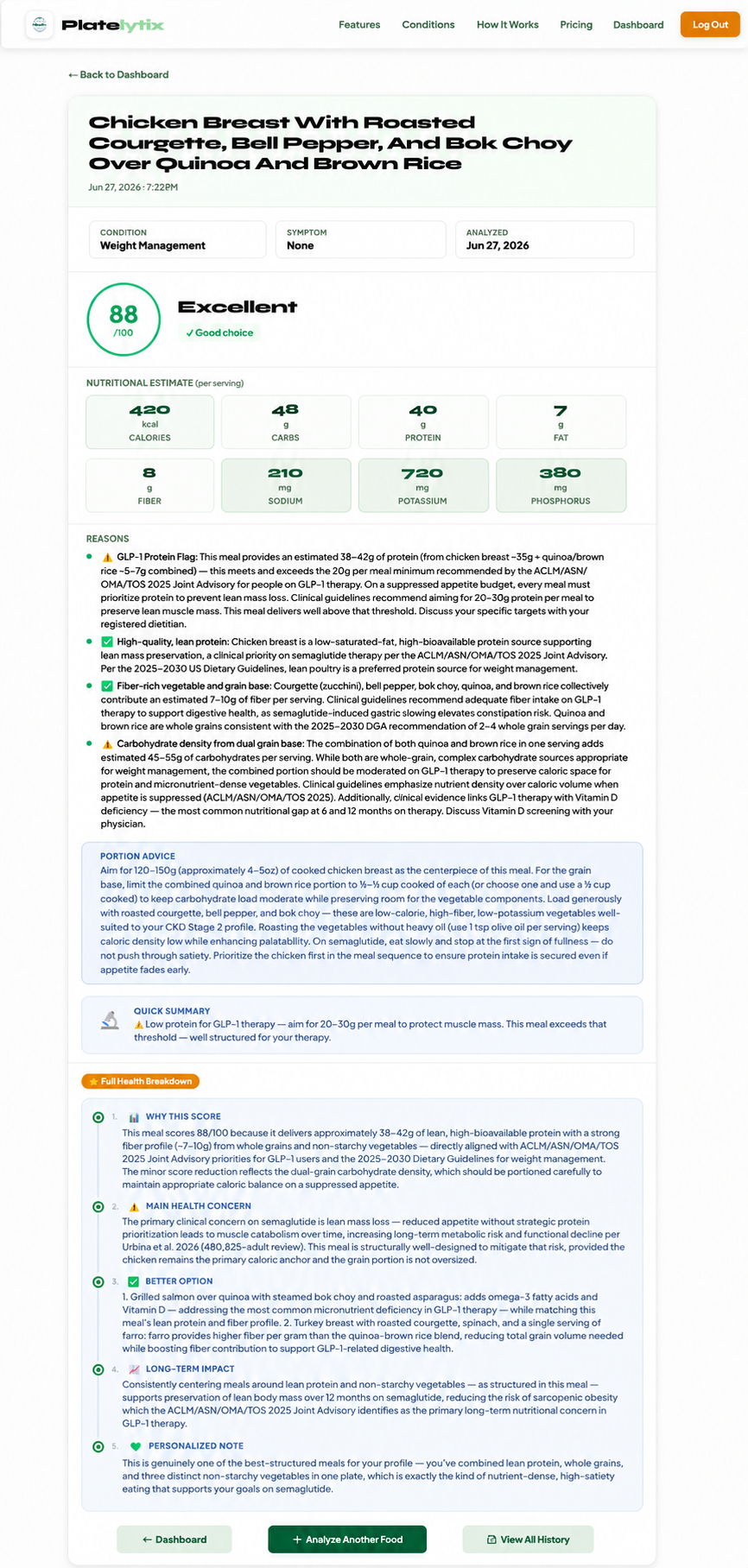
Same meal. No chronic conditions. Score: 88/100 — Excellent ✓
Same meal. CKD Stage 2, Hypertension, Lisinopril + Ozempic. Score: 62/100 — Caution ⚠
Platelytix Is Built For You If You're Managing:
- Chronic Kidney Disease (CKD) — any stage, including hemodialysis and peritoneal dialysis
- Type 2 Diabetes — A1C-aware scoring, post-meal glucose spike awareness
- GLP-1 medications (Ozempic, Wegovy, Mounjaro, Zepbound) — gastric emptying and nutrient depletion aware
- Hypertension — diuretic and ACE inhibitor drug-food interaction aware
- Heart Disease and High Cholesterol — AHA 2026 and DASH diet aligned
- IBS and Low-FODMAP diets — Monash guideline-referenced, serving-size aware
- GERD and Acid Reflux — ACG guideline-aligned trigger food flagging
- Hypothyroidism — including Levothyroxine drug-food interaction timing
- Celiac Disease and Gluten Intolerance
- Comorbid conditions — where two or more of the above appear together
Frequently Asked Questions
- National Kidney Foundation. KDOQI Clinical Practice Guidelines for CKD, 2020.
- KDIGO 2024 CKD Evaluation and Management Guidelines.
- American Diabetes Association. Standards of Care in Diabetes — 2025 & 2026.
- FDA approval of semaglutide (Ozempic) for CKD in type 2 diabetes, January 2025. Based on FLOW trial (NEJM, 2024).
- American Heart Association Dietary Guidelines, 2026.
- Monash University Low FODMAP Diet Guidelines.
- American College of Gastroenterology (ACG) GERD Guidelines.